
Disperse Dyes
WIDE RANGE OF COLORS WITH HIGH RESISTANCE TO LIGHT.
The disperse dyes are non-ionic dyes, which are applied to the polyester fiber by exhaustion, which requires the addition of certain surfactants with dispersing properties. Disperse dyes are insoluble or have very low solubility in water. The theory of dyeing with disperse dyes is based on the fact that the dyes to penetrate the polyester fiber must first be dissolved in the dyeing bath, then be absorbed by the fiber and finally diffused within it.
QUIMIGEN S.A.C offers a wide range of disperse dyes with very good light fastness properties, being able to obtain a huge variety of shades of excellent quality.


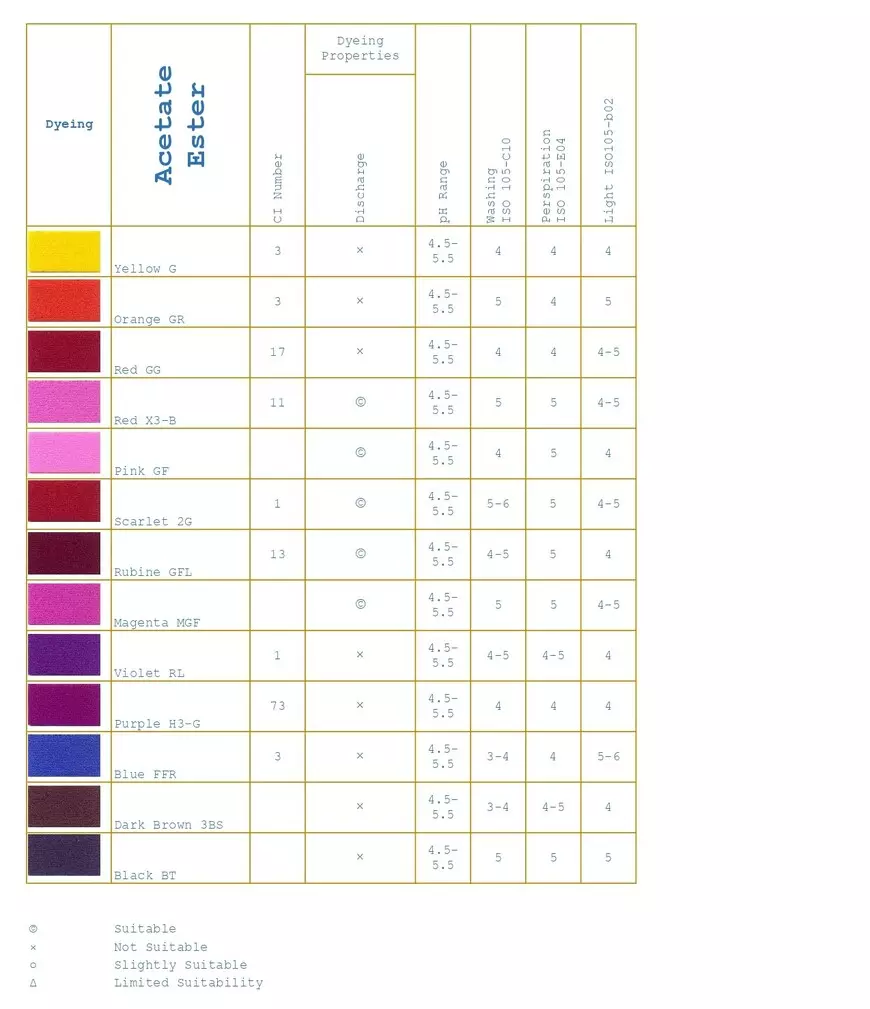
Introduction
Disperse dyes can be used for dyeing and printing of polyester fibers and polyester fiber blends. In exhaust dyeing, the most important method of application is high-temperature process.
Besides high-temperature process, Disperse dyes can also be used for the carrier process and in continuous dyeing by the thermosol process. In printing, fixation can be achieved depending on the sublimation properties either by HT steaming, hot air or by pressure steaming. We have covered almost all the properties of disperse dyes in this shade card. A lot of technical efforts have been taken to ease the implementation process of disperse dyes for the customers.
Dyestuff
Disperse dyes can be mainly divided en 3 basic structure:
1) Azo
2) Anthraquinone
3) Special dyes
As per the dyeing properties, the dyes can be classified as follows:
E Type Features
. Good leveling property.
. Suitable for pale medium shade.
. Suitable for carrier dyeing as well high-temperature dyeing.
SE Type Features
. Good exhaustion type at medium dyeing temperature.
. Good leveling property.
. Good sublimation fastness.
. Suitable for pale-deep shade by high temperature, carrier, thermosol dyeing and printing.
S Type Features
. Good for exhaustion at high dyeing temperatures.
. Excellent sublimation and high stability for various finishing processes.
. Suitable for medium-deep shade by high temperature, thermosol dyeing and printing.
Dyeing Of Polyester Fibers
Polyester fibers have excellent properties in terms of:
. Strength
. Wear Resistance
. Resistance to chemicals
. Wash and wear properties
. Bulkiness
. Stretch properties
The following are the dyeing methods for polyester fiber:
. High Temperature
. Carrier
. Thermosol dyeing
. Thermosol printing
Practical dyeing methods may vary according to the kind of blended fiber, and various fastness and handling are required.
PRETREATMENT
The pretreatment and dyeing methods vary based on the form in which this substrate is being processed:
. Polyester loose material
. Tops, knit goods, or woven fabric
. Spun polyester
. Filament, textured polyester filament
. 100% polyester fiber or blends
Pretreatment serves for
. Removing sizes, preparations, and soil from the surface of the fiber.
. In the case of knit and woven goods serves for relaxation and bulkiness
. In the case of polyester / cellulose blends, desizing and mercerizing must be carried out prior to scouring.
SCOURING
Desizing and scouring must be carried out prior to dyeing
BLEACHING
Bleaching is an optional step. If a higher degree of white is desired, optical bleaching agents must be used.
HEAT SETTING
Heat setting is required to stabilize the polyester fabric. Ensuring the piece goods retain its shape during all the stages. Generally, it depends on the nature and structure of the fabric.
Ph VALUE of Dyes
Ph needs to be maintained after all auxiliaries and dyes are added. A buffer system is used to maintain constant pH throughout the dyeing process.
DYEING
Disperse colors are usually high-temperature dyes. In the majority of cases, it is used in powder/ granule form. The 2nd option available is paste form which is 50%-80% content concentration of the powder product. Generally, lukewarm water [40°-50°C] is added with stirring to complete the dispersion.
. THIGH TEMPERATURE DYEING
The dye batch must be controlled to Ph 4.5-5 using weak acid such as acetic acid or with buffer using sodium acetate to promote the reproducibility of dyeing or to maintain the brilliance of shade.

Standard Recipe:

Then reduction clearing is done.
.CARRIER DYEING
Only selected dyes can be used in carrier dyeing because the exhaustion and build up property are rather poor.
Compared to temperature dyeing covering property is also poor.
Standard Recipe:

And than Reduction clearing is done.
.THERMOSOL DYEING
Thermosol dyeing is employed as a continuous dyeing mainly for polyester/ cotton blends, because of very high fixing temperature around 200°C. Dyes with high sublimation fastness are recommended for thermosol dyeing.
Liquid grade dyes are recommended for thermosol dyeing. It becomes easy to handle when pad liquor is being prepared.
For 100% polyester following process is followed:

THERMOSOL PRINTING
A) HIGH PRESSURE STEAMING METHOD:
RECIPE of color paste
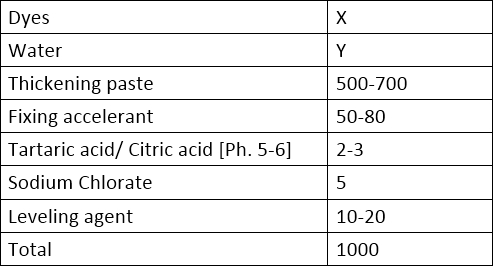
After printing and drying, steamed for 20-30 min at 130°C, then washed with cold and warm water, and reduction clearing.
B) HIGH TEMPERATURE STEAMING [HT Steaming]/ DRY HEAT FIXATION
RECIPE for Colorpaste

After printing and drying, steamed with super heat steam for 5-10 min at 170°-180°C, then washed with cold and warm water, and reduction clearing.

No products were found matching your selection.
